
CITY HALL — With a series of massive tax hikes behind them, the City Council is expected to approve Mayor Rahm Emanuel's $8.2 billion spending plan Wednesday.
Unlike last year, the budget contains no major property tax or sales tax hikes, setting the stage for it to sail through the council.
Laurence Msall, president of the Civic Federation, a business-oriented government watchdog, has praised the budget, saying the city's finances are "in much better shape" than a few years ago.
Here's what that budget means for you:
• More money for police officers
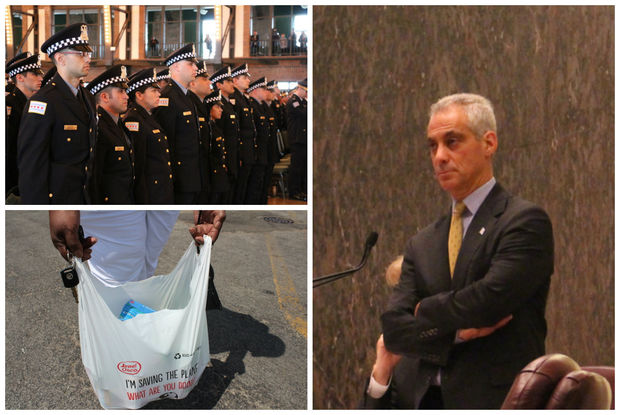
The spending plan includes $60 million to hire 250 new officers, 92 new field-training officers, 100 new detectives, 37 new sergeants and 50 new lieutenants charged with figuring out a way to put an end to more than 3,500 shootings and nearly 700 homicides in 2016.
• Don't forget to bring your own bags to the grocery store
Shoppers will be charged 7 cents for every plastic bag as part of an effort to push Chicagoans to use a reusable tote at grocery stores and avoid sending the bags to landfills.
The fee is expected to add $9.2 million to the city's coffers and help pay for the new police personnel.
• There will be more parking meters — and it will cost more to park near Wrigley Field
The spending plans also calls for 752 new parking meters — 153 in the Loop, with the rest spread throughout the city.
Drivers will also pay $2 more per hour to park at a meter near Wrigley Field starting two hours before Chicago Cubs games and other special events at the Friendly Confines and ending one hour afterward.
• More massive electronic billboards are on the way
The city's 20-year digital-billboard deal would be extended for four more years because there were unanticipated delays in erecting the signs due to weather and legal issues.
Two aldermen have called the deal a failure, and said they oppose its extension because the 100-foot tall advertisements have polluted Chicago neighborhoods and diminished residents' quality of life.
• More investment in low-income Chicago neighborhoods
The mayor has touted the Chicago Community Catalyst Fund as one of a number of strategies his administration is using to restore "vibrancy" to commercial and retail areas of areas like Pullman and Englewood.
But members of the Council's progressive reform caucus have criticized it as "a blank check from Chicago taxpayers to financiers."
• 'Toughest In The Nation' Rules Designed To Curb Opiate Epidemic
The City Council is set to approve a measure that would require Chicago pharmaceutical representatives to be licensed in an effort to end what officials said is an epidemic of deaths from heroin and other opiates.
For more neighborhood news, listen to DNAinfo Radio here.


